
I watched a woman put on the full traditional Minho costume at the Viana do Castelo festival a few years ago. Not a quick dress-up — the whole process. It took forty minutes. The embroidered linen blouse, layered over a corset, over the underskirts, the apron, then the gold filigree pieces — the earrings, the heart-shaped pendant, the filigree cross — pinned in specific positions that correspond to her village and her social status, in a code that hasn’t been forgotten.
At the end she looked extraordinary. She also looked completely comfortable — this is a costume her family has been wearing for festivals since long before she was born. The comfort of familiarity read clearly on her face.
This is what Portuguese traditional clothing is. Not a tourist costume, not a performance — a living tradition that is still practiced because people want to practice it, tied to place and identity in ways that formal costume never achieves.
BLOCK_0
Why Portuguese Regional Costume Is Worth Understanding
Portugal’s folk costume tradition is one of the most geographically varied in Europe. Because the country’s regions were relatively isolated until modern transport infrastructure, each area developed distinct visual languages for dress — different embroidery styles, different colour palettes, different garment constructions, different textile traditions.
The result is that traditional costume in Minho (northwest) looks almost nothing like traditional costume in Alentejo (south-centre), which looks nothing like traditional dress in Algarve, which looks nothing like what’s preserved in Trás-os-Montes.
Understanding these differences transforms your experience of folk performances, craft markets, and the embroidery and jewellery you’ll encounter in shops throughout the country.
The Minho Region: Portugal’s Most Elaborate Tradition
The northwestern Minho region produces the most visually spectacular Portuguese traditional costume, worn most completely at the annual Festas de Nossa Senhora d’Agonia in Viana do Castelo (typically in late August).
The Women’s Costume
The Minho women’s costume consists of multiple layers: embroidered linen or cotton blouse, corset in dark wool or velvet, layered petticoats, an embroidered apron, and a shawl. The embroidery is characteristic — bright primary colours (particularly red and green) in geometric and floral patterns, with each village and each family having slightly different design traditions.
The gold filigree jewellery worn with the costume is part of the same tradition. Gold filigree heart pendants (corações de Viana), large crescent-shaped earrings (arrecadas), and elaborate chains and brooches have been made in the workshops of Viana do Castelo and Póvoa de Varzim for centuries. In a traditional Minho costume, the jewellery represents accumulated family wealth — gold filigree pieces passed down through generations.
The Men’s Costume
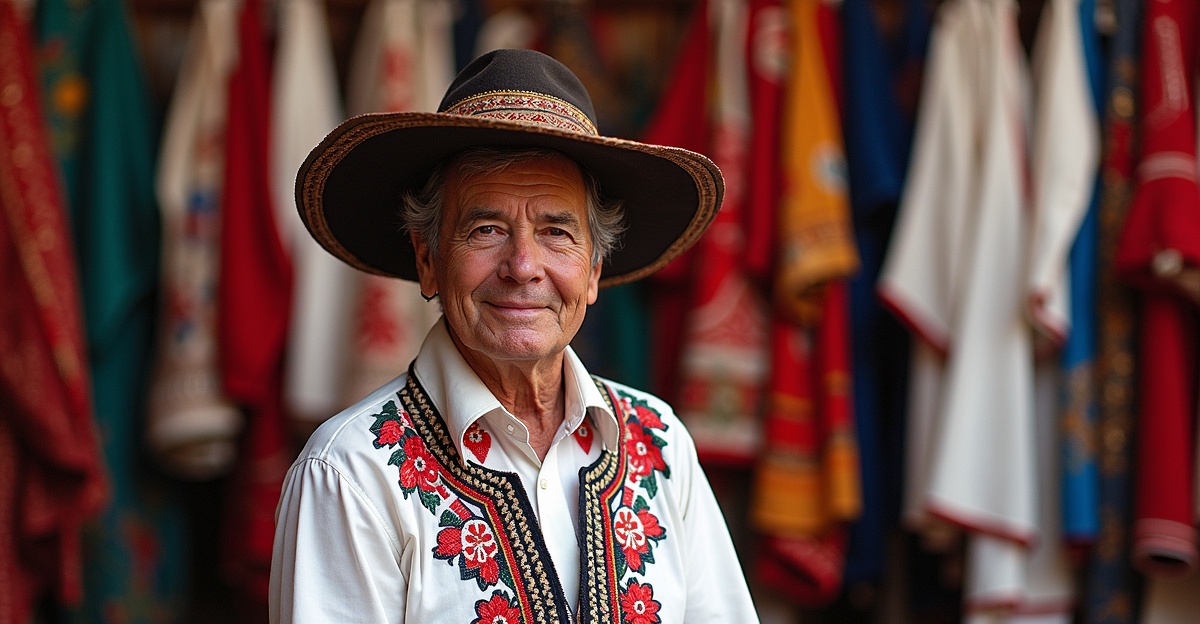
Simpler but distinctive: linen trousers and shirt, a dark wool jacket, a characteristic hand-knitted red wool hat (barrete) that identifies the wearer as Minhoto. Shepherds’ capes of dark rough wool with pointed hoods are also traditional.
The Ribatejo Region: The Campinos
The Ribatejo region (around the Tagus valley) produced a distinct folk type: the campino, the cattle-herder on the marshlands. The campino’s traditional dress includes green trousers, a red waistcoat, a barrete verde (green stocking cap), and is associated with the bullfighting and horse culture of the Ribatejo. You’ll see this costume at Ribatejo festivals and at traditional bullfights in the Ribatejo style.
Alentejo: Simplicity on the Plains
The Alentejo costume reflects the landscape — vast, hot, dry, agricultural. The clothing is simpler and more functional than the Minho equivalent, with plain linen and cotton predominating. Ochre, brown, and undyed natural linen colours are typical. The women’s costume includes a linen apron and shawl in muted tones; the men’s version includes the montera — a flat-topped wool hat — and a dark cloak.
The simplicity is not impoverishment. The Alentejo textile tradition is beautiful in its restraint, reflecting the same aesthetic as the region’s whitewashed architecture and its plain, honest food.
The Algarve: The Madeiran Hat Connection
The Algarve’s traditional women’s costume is most identified by the four-pointed hat — the monchique or the cartwheel hat — which varies by sub-region. The Algarve chimneys that look like the hats are a well-known architectural form; the hats themselves appear at regional festivals and craft markets.
The embroidery of the Algarve differs from the Minho tradition — it’s more influenced by Moorish geometric patterns, and the colours tend toward warmer oranges and earth tones rather than the cool reds and greens of the north.
Where to See Traditional Costume in Portugal
Viana do Castelo Festas de Nossa Senhora d’Agonia (August): the most complete and authentic display of traditional Minho costume in Portugal. Local families wear inherited costumes; the processions and folk dances are not theatrical — they’re a genuine continuation of a living tradition.
Santarém National Agricultural Fair (June): the Ribatejo costumes and campino culture are on full display.
Any Alentejo village festival: smaller, more informal, but often more genuine than the larger events.
Museu Nacional do Traje (Lisbon): the National Costume Museum holds the most comprehensive collection of historical Portuguese regional costume, with pieces dating from the 18th century. Excellent for context before seeing living costume at festivals.
Buying Traditional Costume Elements
The full costume is not practical as a souvenir. Individual elements are:
Embroidered linens: tablecloths, placemats, napkins, and decorative panels in Minho embroidery patterns are available at craft shops throughout the north and increasingly at quality gift shops in Lisbon. The best selections are in Viana do Castelo and Braga.
Filigree jewellery: Viana do Castelo and Póvoa de Varzim have specialist filigree workshops. Silver filigree heart pendants (corações de Viana) start around €30-50; gold pieces significantly more. A recognised mark of authenticity is the gold or silver hallmark stamp.
Lenços dos namorados: embroidered handkerchiefs from the Minho, traditionally made by women as love tokens for their fiancés. The designs include messages, hearts, and folk motifs. Available at Viana do Castelo craft shops.
Wool blankets and capes: the Serra da Estrela wool tradition produces heavy blankets and shepherd’s capes in natural undyed wool or in traditional earthen colours. Available at cooperatives in the Serra da Estrela region.
BLOCK_1
Frequently Asked Questions About Portugal Traditional Clothing
What is the traditional costume of Portugal?
Portugal doesn’t have one unified traditional costume — each region has its own distinct tradition. The most elaborate and well-known is the Minho folk costume (embroidered linen, gold filigree jewellery), worn at the annual Viana do Castelo festival. The Ribatejo has the campino cattle-herder tradition. The Alentejo has a simpler linen and wool tradition. The Algarve has its distinctive pointed and cartwheel hats.
Where can I see traditional Portuguese costumes?
The best opportunities: the Festas de Nossa Senhora d’Agonia in Viana do Castelo (August), the Santarém National Agricultural Fair (June), and any village saint’s festival in the Minho or Alentejo. The Museu Nacional do Traje in Lisbon holds the finest historical collection. Folk performances at tourist venues in Lisbon and Porto are stylised rather than authentic — the real thing is at regional festivals.
What is the significance of the rooster in Portuguese culture?
The Barcelos rooster (Galo de Barcelos) is a ceramic rooster from the Minho region, now used as an unofficial national symbol. It derives from a folk legend about a pilgrim wrongly accused of theft who was saved by a cockerel crowing at the moment of his execution. The rooster represents faith and good fortune. Authentic Barcelos roosters are made by specialist potters in Barcelos; mass-produced versions are sold throughout the country.
What is Portuguese filigree jewellery?
Portuguese filigree (filigrana) is a jewellery-making technique using fine silver or gold wire twisted and woven into delicate open patterns. The main production centres are Viana do Castelo and Póvoa de Varzim. Traditional pieces include heart-shaped pendants (corações de Viana), large crescent earrings (arrecadas), and elaborate crosses. The technique is centuries old and is maintained by specialist workshops.
What embroidery is Portugal famous for?
Viana do Castelo embroidery from the Minho region — bright geometric and floral patterns on linen in red, green, yellow, and blue — is the most internationally recognised. The embroidery of Castelo Branco (Bordados de Castelo Branco) uses a different technique and colour palette: warm oranges and purples with flowing plant and bird motifs on silk. Both are genuinely beautiful and sold at quality craft shops throughout Portugal.
BLOCK_2
BLOCK_3