
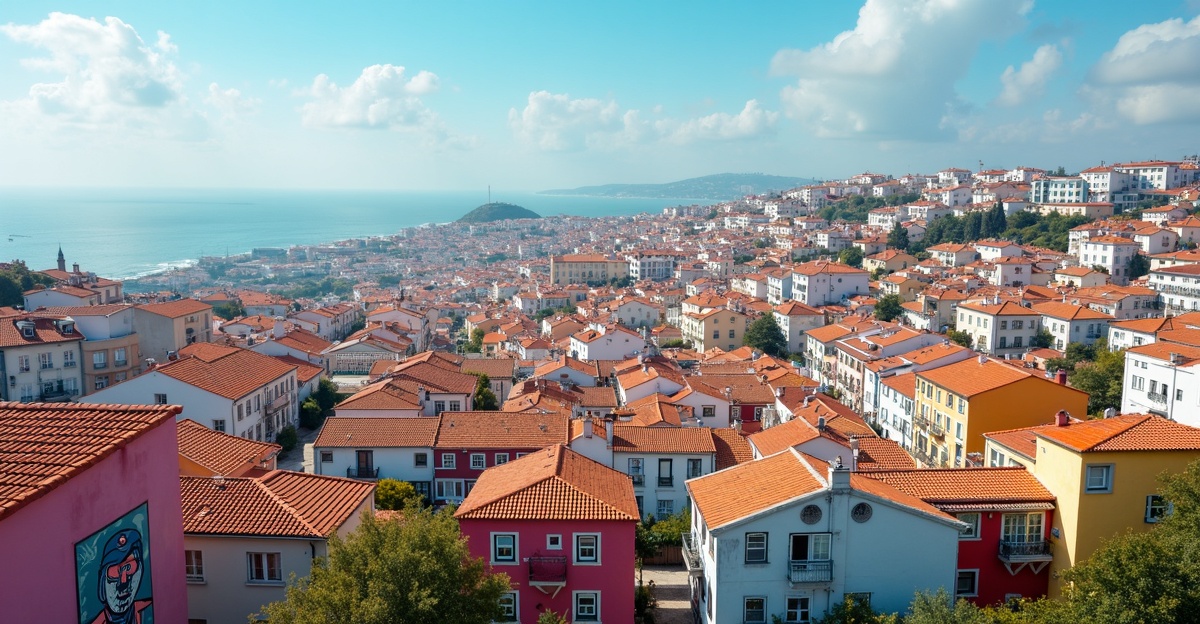
Amadora became a city in 1979, separated from the municipality of Sintra after years of population growth had made it Portugal’s fourth-most-populated urban area. Before that it was a collection of suburbs that grew without much planning around the railway stations on the Lisbon-Sintra line. It has the character of a place that became a city before it knew what kind of city it wanted to be — which is to say, it’s genuinely interesting in the way that unplanned places often are.
Most people experience Amadora as a series of train stations between Lisbon and Sintra. The journey takes you through urban Portugal in a way that the tourist trail doesn’t show: dense apartment blocks, social housing estates, markets, traffic, the ordinary life of a mid-size Portuguese city without any particular scenic advantage.
But stop at Amadora Este station and walk to the Museu Nacional de Banda Desenhada, and you’ll find one of the best specialist museums in the country, housed in a building that’s also excellent, displaying art that’s seriously good.
BLOCK_0
What Amadora Is
Amadora is a city and municipality of approximately 175,000 people in the Lisbon Metropolitan Area, bordering Lisbon to the north and Sintra to the northwest. It’s Portugal’s most densely populated municipality — more people per square kilometre than Lisbon itself, concentrated in a relatively small area.
The city’s population is notably diverse. Amadora has one of the highest percentages of residents of African descent (particularly Cape Verdean, Angolan, and Mozambican communities) in Portugal, the legacy of migration in the post-colonial period after 1974. This demographic diversity shapes the city’s food, music, and cultural identity in ways that distinguish it from the more homogeneous Lisbon suburbs to the west.
Amadora is not a tourist destination in any conventional sense. There’s no historic centre, no castle, no memorable skyline view. What it has is an authentic urban character, a good comics museum, excellent African food, and a train connection to practically everything that matters in the region.
The Comics Museum: The Real Reason to Visit
The Museu Nacional de Banda Desenhada (National Comics Museum) is the best thing in Amadora and one of the best specialist museums in Portugal. It occupies a contemporary building near Amadora Este station and houses the national collection of Portuguese comics, illustration, and sequential art — from 19th-century satirical cartoons to contemporary graphic novels and international work.
The museum grew out of the Amadora International Comics Festival, which has been running since 1982 and is one of the longest-established comics festivals in Europe. The collection documents Portuguese comics history in depth — a tradition that includes significant satirical illustration going back to the 19th century and a contemporary graphic novel scene that’s genuinely good.
For visitors: the permanent collection is strong, the temporary exhibitions are ambitious, and the shop is one of the best places in Portugal to buy Portuguese illustration and graphic novel work. The museum also regularly hosts signings and presentations by Portuguese and international comics artists.
Hours and prices vary; check the current schedule before visiting. Entry is typically €3-5.
Food in Amadora: African Cuisine and Local Markets
Amadora’s food culture reflects its demographics. Cape Verdean restaurants serving catchupa (a slow-cooked stew of corn, beans, and meat or fish) and Angolan restaurants serving muamba (chicken stew with palm oil and okra) are part of the ordinary fabric of the city’s eating in a way that’s not the case in most other Portuguese cities.
For Cape Verdean food specifically: the area around Damaia (accessible from Amadora station) has the highest concentration of Cape Verdean restaurants and cafés in Portugal outside Lisbon’s Mouraria and Cova da Moura. This is where the diaspora community eats, not where tourists go — which means the food is the real thing and the prices are low.
The Mercado de Alfornelos in the Alfornelos area is a local food market worth visiting on a weekday morning — fresh produce, fish, and the small café-like stalls around the edges serving breakfast food (toasted bread, bifanas, coffee) to market workers and early shoppers.
Amadora as a Base for Day Trips
Amadora’s main practical advantage is its rail connectivity. From Amadora stations (there are three: Amadora, Amadora Este, and Reboleira), trains connect quickly to:
Sintra (15-20 minutes from Amadora station): the UNESCO World Heritage palace town with Pena Palace, the Moorish Castle, and the Quinta da Regaleira. The busiest tourist day trip from Lisbon, but accessible and straightforward from Amadora.
Queluz (10 minutes from Amadora station): the Palácio Nacional de Queluz, Portugal’s Versailles — a baroque royal palace with formal gardens that’s considerably less crowded than Sintra and genuinely excellent. Often overlooked because it’s on the route to Sintra; worth treating as a separate destination.
Lisbon (15-20 minutes by train to Rossio or Oriente): the capital is the obvious excursion. Every Lisbon attraction is accessible from Amadora within 30-40 minutes door-to-door.
Mafra (40 minutes by bus): the monumental convent-palace of Mafra, built in the 18th century by João V to fulfil a vow made at the birth of his heir. One of the largest baroque buildings in Europe and far less visited than it deserves.
Practical Amadora Information
Getting there: trains on the Sintra line from Lisbon Rossio run every 10-15 minutes and stop at Amadora and Amadora Este. Journey time from Rossio: approximately 20 minutes to Amadora, 22 minutes to Amadora Este. The Reboleira station on the Blue Metro line also connects to Amadora Este.
Where to stay: Amadora has limited tourist accommodation but is a practical base for visiting the region. Several budget and mid-range hotels near the stations; most travellers visiting the region base themselves in Lisbon or Sintra.
Language: Portuguese is the primary language; English is less commonly spoken than in Lisbon’s tourist areas but widely understood by younger residents.
BLOCK_1
Frequently Asked Questions About Amadora Portugal
What is Amadora known for?
Amadora is primarily known within Portugal as the country’s most densely populated municipality and as one of the major urban centres of the Lisbon Metropolitan Area. Internationally, the city is associated with its long-running International Comics Festival (since 1982) and the resulting Museu Nacional de Banda Desenhada (National Comics Museum), which houses the national collection of Portuguese comics and illustration. The city’s significant Cape Verdean and Angolan communities have also made it a centre for African-Portuguese cuisine and music.
Is it worth visiting Amadora as a tourist?
For most visitors to Lisbon, Amadora is not a primary destination — there’s no historic centre or iconic sightseeing. The worthwhile specific visit is the Museu Nacional de Banda Desenhada for anyone interested in illustration, comics, or graphic art. The city’s African food scene (particularly Cape Verdean restaurants in the Damaia area) is another reason to cross into Amadora. As a transit point, the train connection to Sintra, Queluz, and Lisbon makes Amadora stations part of every regional rail journey.
How do you get from Lisbon to Amadora?
The Sintra suburban rail line from Lisbon Rossio station stops at Amadora (approximately 20 minutes) and Amadora Este (approximately 22 minutes). Trains run every 10-15 minutes throughout the day. From Lisbon Oriente, the Blue Metro line connects to Reboleira station on the edge of Amadora. The journey from central Lisbon is fast and cheap.
What is the Comics Museum in Amadora?
The Museu Nacional de Banda Desenhada is Portugal’s national comics museum, located near Amadora Este station. It houses the national collection of Portuguese comics, illustration, and sequential art, with particular strength in 19th and 20th-century satirical illustration and contemporary Portuguese graphic novels. The museum grew from the Amadora International Comics Festival and maintains active programming including temporary exhibitions, artist signings, and educational events. It’s one of the best specialist museums of its kind in Iberia.
What is the best day trip from Amadora?
Queluz is the most underrated day trip from Amadora — the Palácio Nacional de Queluz (10 minutes by train) is a major baroque royal palace with elaborate formal gardens that receives a fraction of Sintra’s crowds despite comparable quality. Sintra itself (15-20 minutes by train) is the obvious major day trip. For a different experience, Mafra’s monumental convent-palace (40 minutes by bus) is worth the trip for its extraordinary scale and relative obscurity.
BLOCK_2
BLOCK_3
BLOCK_4