
I was eight years old the first time my father brought me a Portugal shirt. He’d queued at a sports shop on Rua Augusta — back when Rua Augusta had actual shops, before the tourist wave turned it into postcards and magnets — and came home with this heavy red jersey that smelled like new plastic. I wore it until the seams split. That shirt had nothing to do with Ronaldo, nothing to do with Nike, nothing to do with any of the commercial machinery that surrounds Portuguese football today. It was just red and green and ours.
That feeling hasn’t changed. The Portugal shirt still does something to people. You see a Portuguese person in the airport wearing one and there’s an instant recognition, a little nod. You see a foreign visitor pulling one out of a gift bag at the end of a trip and you can tell they genuinely wanted it — not just a magnet, not a tin of sardines, but this. The shirt.
This guide is everything you need to know before you buy one.
A Brief History of the Portugal Football Kit
Portugal has been playing international football since 1921, but the red-and-green colour story goes back further than most people realise. The colours come from the Portuguese flag itself — the red of the country’s republican revolution and the green of hope, as the symbolism goes. In the earliest decades, the kit design varied considerably. Some archives show different shades, different collar styles, the crest moving around. It wasn’t until the mid-twentieth century that the kit settled into the recognisable form we know today.
The Quinas — those five small blue shields arranged in a cross pattern on the Portuguese coat of arms — are the centrepiece of the crest. Each shield carries five white dots representing the five Moorish kings defeated at the Battle of Ourique in 1139. It’s the kind of historical detail that makes the crest feel heavy with meaning rather than just decorative. When you’re wearing a Portugal shirt, you’re wearing a fragment of that history on your chest.
The Federation badge — the FPF crest — sits alongside the manufacturer logo. For decades, that manufacturer was Umbro, then adidas. Nike came in 1996 and has been the kit manufacturer ever since, which means the entire Luís Figo era, the entire Ronaldo era, every major tournament Portugal has played in the modern era, has been a Nike shirt.
The Red and Green Debate
There’s actually a long-running discussion among Portuguese football fans about the exact shade of red. The traditional home shirt is a deep, almost crimson red. In recent years, Nike has shifted it slightly — some editions look more of a true scarlet. Older supporters (my father among them) will tell you the classic deep red is the only correct one. The younger generation barely notices. Either way, both home and away kits carry green details — green collar, green trim, green on the shorts or socks depending on the edition.
The away kit changes more dramatically. Portugal has worn white, dark navy, all-black editions. The 2022 World Cup saw a striking dark green away shirt that divided opinion furiously and sold out almost everywhere. Controversy always drives sales.
The Nike Partnership — What It Changed
Nike took over from adidas in 1996 and it fundamentally altered the commercial reach of the Portugal shirt. Before Nike, the kit was a domestic product with limited international distribution. After Nike, it became part of a global sportswear machine. Nike’s sponsorship deal gave the federation money to develop football infrastructure and gave the shirt international retail distribution it had never had before.
The timing mattered enormously. In 2004, Portugal hosted Euro 2004 and reached the final. Luís Figo was at the peak of his powers. Deco, Rui Costa, Maniche — the squad was genuinely special. The Portugal shirt sold in significant numbers across Europe. Then came Cristiano Ronaldo’s emergence, and everything accelerated.
Nike designs the Portugal kit on roughly a two-year cycle, timed to major tournaments. Each new release generates media coverage, discussion, and sales spikes. The 2024 Euro kit — which Portugal wore in Germany — was a return to a more classic silhouette, deep red with subtle textural detail in the fabric, the Quinas crest clean and prominent. It was widely considered one of the better kits Nike had produced for Portugal in years.
Authentic vs Replica — This Is the Important Part
There are two versions of the official Portugal shirt that Nike produces, and understanding the difference will save you money or help you justify spending more.
The Authentic shirt (sometimes called the Player Version) is the same specification as what the players wear on the pitch. It uses Nike’s Dri-FIT ADV technology — a moisture-wicking, aerodynamic fabric that’s engineered for movement. The badge is heat-pressed, the finish is extremely precise, and the fit is athletic. These shirts retail around €120 to €140 in Portugal. They’re worth it if you’re a serious collector or want exactly what Ronaldo wears. They are not what most people need.
The Stadium version (the replica) is designed for supporters. It uses standard Dri-FIT polyester, the badge is embroidered, and the fit is more relaxed. These retail around €90 to €100. This is the shirt most people buy, most people wear to matches, and most people are perfectly happy with. The quality is genuinely good — Nike’s mass-market products have improved substantially.
Then there are the knockoffs. I’ll get to those.
Authentication details to check when buying: the shirt should have a Nike hangtag, a separate FPF (Federação Portuguesa de Futebol) authentication tag, and a QR code on the inner label that links to Nike’s product page. The embroidery on the Quinas should be clean and tight — fakes almost always have loose, uneven stitching on the shields. The weight of the fabric on a real Nike Stadium shirt is noticeably different from a cheap replica.
The Ronaldo Effect on Portugal Shirt Sales
It’s impossible to write about the Portugal shirt without writing about Cristiano Ronaldo. The man has been wearing number 7 for the national team since 2004. That’s over twenty years. For an entire generation of football fans globally — in Brazil, in Indonesia, in Saudi Arabia, in Nigeria — the Portugal shirt is Ronaldo’s shirt. The red, the green, the number 7, the CR7 branding.
When Ronaldo signed for Manchester United in 2003 and emerged as a global superstar, Portugal shirt sales globally increased in ways that the federation had never seen. When he won the Ballon d’Or for the first time in 2008, they spiked again. The 2016 Euro win — Portugal’s first major international trophy, in France, against the hosts — sent them through the roof.
The number 7 shirt with Ronaldo’s name on the back is still the single most requested personalisation at every official retailer in Portugal. Even now, even after he’s spent two seasons at Al Nassr in Saudi Arabia, even as younger stars like Bernardo Silva and Rafael Leão have taken over the creative heart of the team. The CR7 shirt remains iconic.
This does create a minor dilemma if you’re buying for a child or a passionate young fan. Do you go Ronaldo — safe, universally recognised — or do you go with a player who’s more central to the current squad?
Other Players Worth Putting on Your Back
If you want a shirt that reflects the current Portugal team rather than its legend, these are the names that make sense:
Bernardo Silva — possibly the most complete midfielder in world football right now. A Benfica youth product who went on to win multiple Premier League titles with Manchester City. His name on a Portugal shirt feels current and intelligent.
Bruno Fernandes — the captain, the talisman, the man who wears the armband with obvious intensity. He’s divisive among neutrals but beloved by Portuguese fans.
Rafael Leão — the AC Milan winger who plays with a kind of relaxed, almost casual brilliance that masks how effective he actually is. Popular choice among younger supporters.
Diogo Jota — sadly sidelined by serious injury in 2024/2025, but remains a hugely popular name among supporters who followed his development through the years.
The choice of name is personal. But if you’re buying for someone else, Ronaldo 7 remains the fail-safe option.
Where to Buy the Official Portugal Shirt in Portugal
This is where I want to be genuinely useful, because the number of places selling fake or grey-market Portugal shirts in Lisbon and Porto is significant. Buying from the right place matters.
Nike Store — Centro Comercial Colombo, Lisbon
The Nike flagship store at Colombo (Avenida Lusíada, Benfica — easily reached by Metro on the blue line to Colégio Militar/Luz) carries the full range of Portugal shirts in all sizes and versions. You’ll find Authentic and Stadium versions, women’s fit, youth sizes, and the full personalisation service with official Nike lettering and numbering. The staff know the product well.
Colombo is a massive shopping centre with reasonable parking and excellent transport links. Not the most atmospheric place to buy a shirt, but definitely the most complete.
FPF Official Shop
The Portuguese Football Federation runs its own retail operation. The FPF shop at the Cidade do Futebol — the federation’s headquarters in Oeiras, on the Lisbon coast — is the most complete Portugal football retail experience in the country. You’ll find official merchandise that goes well beyond shirts: training gear, balls, scarves, replica trophies, children’s kits, everything.
Getting to Oeiras from central Lisbon requires a train from Cais do Sodré (Cascais line) or a car. It’s worth the trip if football is your primary reason for being in Portugal. The atmosphere alone — you’re at the actual federation base — makes it special.
The FPF also operates a pop-up or concession in some Lisbon shopping centres, particularly around tournament time. Check their website (fpf.pt) before your trip for current retail locations.
Fnac Portugal
Fnac — the French electronics and culture retailer — has several stores in Lisbon and Porto and stocks official Nike Portugal shirts at the same RRP as the Nike store. The Fnac at Colombo and at Chiado both tend to carry stock. Fnac is worth knowing because they run regular promotions and discount days (including their Black Friday sales) where the shirt may be cheaper than the Nike store.
The selection at Fnac is narrower than at the Nike flagship — usually Stadium version only, limited sizes, no personalisation service — but if you happen to be in Fnac for something else and spot the shirt at a discount, it’s completely legitimate.
SportZone and Decathlon
SportZone (a Portuguese chain, now owned by JD Sports) stocks official Nike Portugal kit in most large branches. Decathlon does not sell branded federation shirts — they have their own football training kit — but SportZone carries the full official range. Branches at Vasco da Gama mall in Oriente (next to Lisboa Oriente station) are convenient if you’re travelling by train or arriving from the airport area.
What to Avoid — Tourist Area Knock-Offs
I want to be direct about this. Rua Augusta in Baixa, the streets around Alfama, the tourist markets near Praça do Comércio, and various stalls around the Belém waterfront are full of Portugal shirts that are not official Nike products. Some of them look reasonably convincing from a distance. Up close, the Quinas stitching is uneven, the fabric is lighter and flimsier, and the authentication tags either don’t exist or are printed paper rather than woven labels.
These shirts typically retail for €15 to €30. That price point is the first giveaway — an official Stadium shirt costs €90 to €100. There is no legitimate channel through which you can buy a genuine Nike Portugal shirt for €25.
I understand the temptation. You’re on holiday, you want to bring something back, and €25 is much easier to swallow than €90. But the quality difference is significant and the fake will not hold up through more than a few washes. The stitching comes apart, the colours fade unevenly, and the Quinas distort.
If budget is a genuine concern, look for last-season’s official shirts in clearance — the previous generation kit is often available at 30% to 40% off at Nike’s outlet section or at SportZone clearance racks. You get a real shirt, properly made, just not the current design.
The 2024/2025 Euro Kit — Current Details
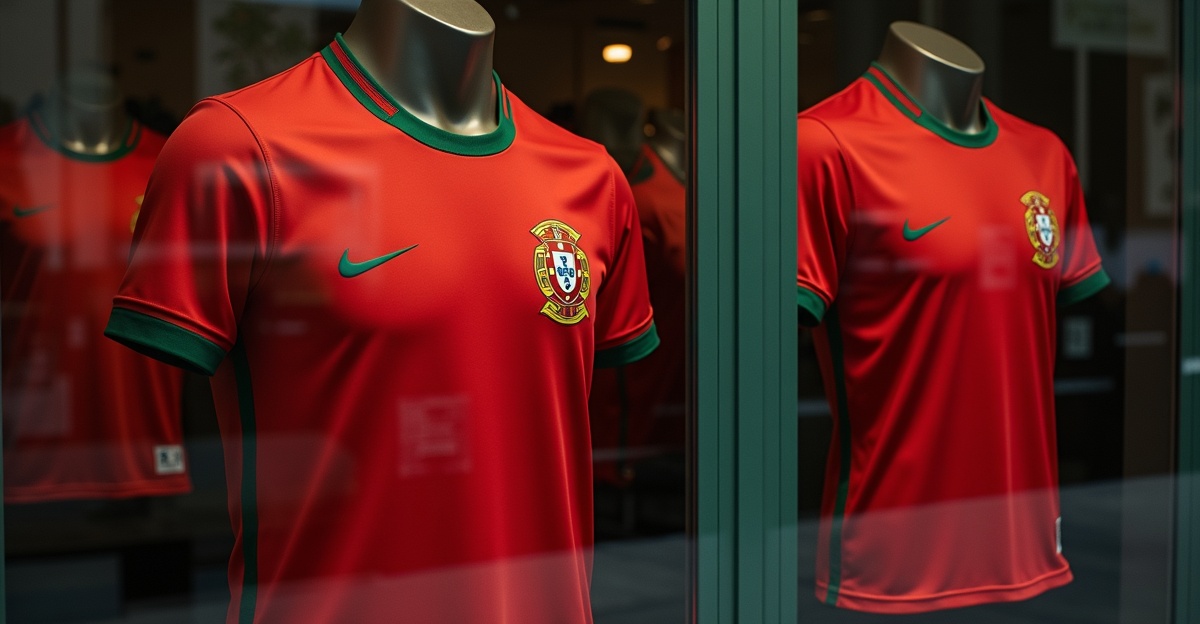
The kit Portugal wore at Euro 2024 in Germany has continued into the 2024/2025 cycle pending any design changes for the next round of fixtures. The home shirt is deep red with subtle geometric texture in the fabric — visible only up close under certain light — and a clean crew collar with a thin green stripe. The Quinas crest is embroidered clearly on the left chest with the FPF badge beneath it. The Nike swoosh sits on the right chest.
The shorts are red with minimal green detailing. Home socks are red with green trim at the top. The away kit for the same cycle uses a darker colourway — dark green was the most recent away, though kit releases can shift with the football calendar.
For women’s and youth sizes: Nike produces Portugal shirts in women’s specific fit (different cut, same design) and in junior sizes from roughly age 3/4 up through XL junior. The women’s fit is worth knowing about because it’s a genuinely different garment — not just a smaller men’s shirt — and it’s available at the Nike store at Colombo and through Nike’s website.
Personalising Your Portugal Shirt
Every official Nike retailer with the proper print-on-demand setup can personalise a Portugal shirt with an official name and number. The process uses official Nike lettering — the correct font, the correct placement, the correct size — rather than aftermarket prints.
If you’re having a shirt personalised at a Nike store, you typically choose from a list of current and recent squad names for official tournament-edition shirts, or you can request any name up to a certain character limit for the current season shirts. Ronaldo 7 is always available. Custom names (your own name, a surname, a nickname) are available on season shirts but may not be approved on player-spec match-day editions.
Allow time for personalisation. The process is usually done in-store with a 30 to 60 minute wait, but during busy periods (summer, tournament windows) it can be longer. Calling ahead or booking through Nike’s website where possible is sensible.
One important thing: personalised shirts generally cannot be returned or exchanged. Be certain of the name and number before you hand it over.
Portugal Shirt as a Gift
Taking a Portugal shirt home as a gift is an excellent idea — if you buy the right one. It travels well, it’s lightweight, it packs flat, and it says something specific about Portugal rather than generic tourist-gift. A personalised shirt with the recipient’s name on the back, or with Ronaldo 7, is a genuinely thoughtful present.
The key things for a gift: check the size carefully (Portuguese and European sizing runs slightly smaller than American sizes — a US Large is typically a European XL), keep the receipt, and buy from an official retailer so the gift comes with authentication tags still attached. An official shirt in its original packaging — the Nike poly bag, the hangtag, the FPF sticker — looks like a proper gift. A shirt pulled off a rack on Rua Augusta in a plastic bag does not.
Frequently Asked Questions About the Portugal Shirt
Where is the best place to buy an official Portugal shirt in Lisbon?
The Nike flagship store at Centro Comercial Colombo (Metro: Colégio Militar/Luz) has the fullest selection including both Authentic and Stadium versions, all sizes, women’s fit, youth sizes, and an in-store personalisation service. The FPF official shop at Cidade do Futebol in Oeiras is the most complete football-specific retail experience but requires a short trip out of central Lisbon.
What is the difference between the Authentic and Stadium Portugal shirt?
The Authentic shirt uses Nike’s Dri-FIT ADV performance fabric and is the same specification worn by the players on the pitch. It retails around €120 to €140. The Stadium shirt uses standard Dri-FIT polyester, has an embroidered badge, and retails around €90 to €100. Most supporters buy the Stadium version and are very happy with it.
How can I tell if a Portugal shirt is genuine?
Look for the Nike hangtag, an FPF authentication tag, and a QR code on the inner care label. The Quinas embroidery on a genuine shirt is tight and clean. Fake shirts often have loose or uneven stitching on the shields. Price is also a strong indicator — a genuine Stadium shirt costs €90 to €100. Anything under €40 is almost certainly not legitimate.
Can I personalise a Portugal shirt in Portugal?
Yes. Nike stores with personalisation facilities (including the Colombo flagship) offer official name and number printing using the correct Nike font. Current squad names are pre-approved. Custom names are available on most season shirts. Allow 30 to 60 minutes and note that personalised shirts cannot be returned.
What size should I buy for a Portugal shirt?
Portuguese and European sizing runs slightly smaller than American or British sizing. If you normally wear a US or UK Large, consider an XL. Nike’s website has a detailed sizing chart. When in doubt, size up — the Stadium version has a relaxed fit and can accommodate a slightly larger frame without looking baggy.
Is the Ronaldo Portugal shirt still available even though he plays in Saudi Arabia?
Yes. Cristiano Ronaldo continues to represent Portugal in the national team and the number 7 shirt with his name remains available at all official retailers. It is still the most requested personalisation option at every Portugal shirt retailer in the country.
What is the current Portugal home shirt design for 2024/2025?
The current home shirt is deep red with subtle geometric texture in the fabric, a crew collar with thin green stripe, the Quinas crest embroidered on the left chest, and the Nike swoosh on the right. Shorts are red with green detail; socks are red with green trim. It’s considered one of Nike’s cleaner Portugal designs in recent years.
The Shirt Is Always More Than the Shirt
I think about that jersey my father brought home from Rua Augusta, the one I wore until it fell apart. The Portugal shirt carries weight that goes beyond football. It’s a national symbol that happens to be worn on a pitch. When Portugal won Euro 2016 in France — without playing particularly beautiful football, grinding through draws and nerve-shredding knockout games — and Ronaldo hobbled off injured in the final then stood on the touchline in a tracksuit directing his teammates with tears rolling down his face, and Fernando Santos’s substitutes closed it out, and the whole country erupted — the shirt in that moment was something more than sportswear.
That’s why people want it. That’s why visitors want to take it home. Buy the real one. Buy it from a proper shop. Have someone’s name put on the back if you want. And if you’re ever in Portugal when a match is on — find a café with a screen, order a Super Bock, and wear the shirt.
You’ll fit right in.