
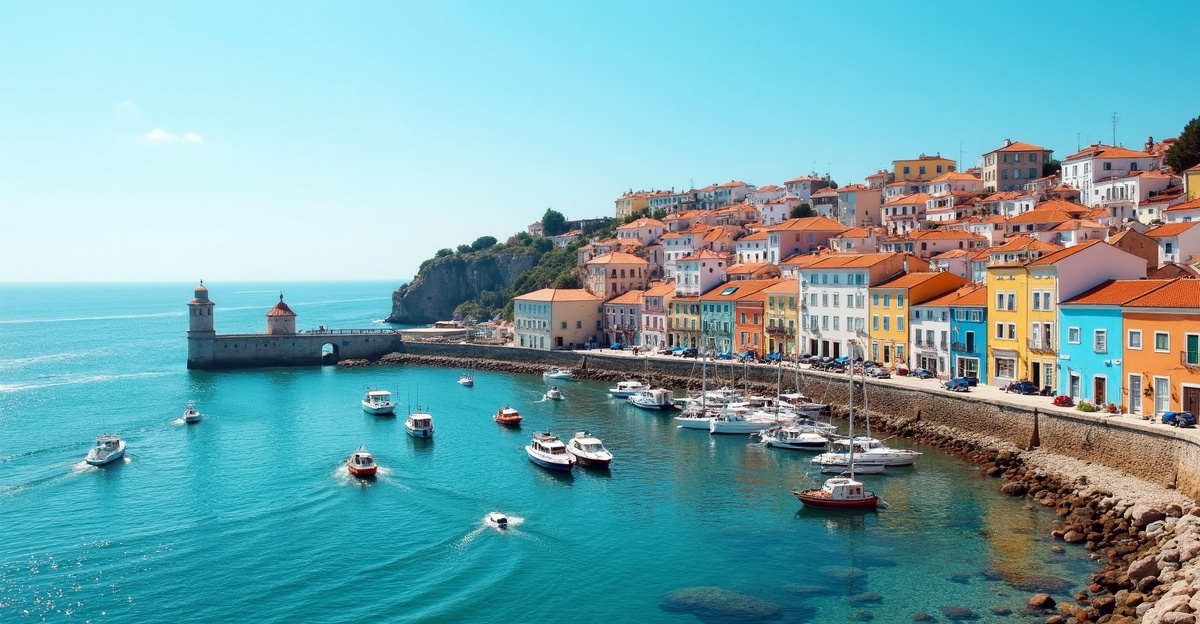
I took the train from Lisbon’s Cais do Sodré to Cascais for the first time on a Tuesday in November, which is, it turns out, the correct way to experience it. No crowds. A grey Atlantic sky that kept breaking into patches of sudden gold. The train runs right along the coast for the last twenty minutes and the views — Estoril, then the open sea, then the rocky headland — made me miss my stop because I was pressing my face against the window like someone who had never seen the ocean before.
Cascais did not disappoint that day. It hasn’t disappointed since, across many visits in different seasons. This is a town with real layers: the grand royal history, the working fishing port, the serious surf breaks, the genuinely excellent seafood restaurants, and a pedestrianised centre that manages to be charming without being precious. It’s forty minutes from Lisbon on the train and it feels like a different country.
Here is what you actually need to know before you go.
BLOCK_0
Why Cascais Is Worth More Than a Day Trip
Most people come to Cascais for a day, tick off the beaches and the town centre, and go back to Lisbon. I understand this completely. But I also think it misses the point, or at least misses a significant part of it.
Cascais spent decades as the summer retreat of the Portuguese royal family. King Luís I and his successors turned what was a modest fishing village into a genuinely sophisticated coastal resort in the second half of the 19th century. The legacy of that period is visible everywhere: in the Citadel that was converted into a royal palace, in the grand villas along the coast road, in the high quality of the restaurants and accommodation, and in a certain understated elegance that the town has never entirely lost.
The town also has a literary and artistic history that is worth knowing. The poet Fernando Pessoa is closely associated with Cascais. Wax creator, novelist Eça de Queirós set his masterwork “The Maias” partly here. During the Second World War, Cascais and Estoril became a gathering point for European exiles and spies — the British agent Ian Fleming reportedly used the Casino Estoril as inspiration for the casino in Casino Royale. None of this background makes Cascais more beautiful. But it makes it more interesting to walk around.
Cascais Beaches: Which One Is Right for You
There are several beaches within easy reach and they are genuinely different from each other.
Praia da Rainha and Praia da Ribeira
These two small beaches sit right in the town centre, sheltered by the curve of the harbour. Calm, warm, family-friendly, and surrounded by cafés and restaurants. They’re not the dramatic Cascais experience but they’re genuinely pleasant and perfect if you have children or just want to sit somewhere easy.
Praia da Conceição and Praia da Duquesa
A short walk west of the centre, these beaches are larger and still relatively sheltered. The Atlantic starts to make itself felt here, but they’re swimmable for most of the year. Good for families who want a bit more space.
Praia do Guincho
This is where everything changes. About ten kilometres west of Cascais, Guincho is a wild Atlantic beach set inside the Sintra-Cascais Natural Park, with dunes, dramatic rock formations, and waves that attract serious surfers from across Europe. It is not a beach for casual swimming in most conditions — the undertow is real and the flag system should be respected absolutely. But as a landscape experience, on a grey autumn afternoon with the wind up and waves breaking over the rocks, it is one of the most powerful beaches I have been to anywhere.
Guincho also has one of Portugal’s most famous restaurants — the Fortaleza do Guincho, a Michelin-starred establishment inside a 17th-century fort right on the beach. I have eaten there once. It was extraordinary. Book months in advance.
Things to Do in Cascais Beyond the Beaches
The Citadel of Cascais
The Citadel is the town’s dominant structure — a 17th-century fortress that was converted into a royal palace in the 19th century and now operates partly as a luxury hotel and partly as a cultural space. The art gallery inside is worth visiting. The views from the walls over the harbour are among the best in town. Entry to the outer areas and gallery is free.
Casa das Histórias Paula Rego
This museum is a genuine surprise and one of the best reasons to stay in Cascais for more than a day. Paula Rego is one of Portugal’s most important contemporary artists — her work is dark, political, narrative, and deeply strange in the best possible way. The building itself, designed by Eduardo Souto de Moura (who later won the Pritzker Prize), is striking: two red-brown conical towers that look like something between a church and a fairytale. The permanent collection includes major works spanning her entire career.
The Old Town and the Fishing Port
Spend a morning walking the old town without a plan. The streets around the Largo de Camões are beautiful, the shop fronts are well-maintained, and the covered market hall near the beach is worth a visit for fresh produce and local snacks. Then walk around the headland to the traditional fishing port — smaller fishing boats still operate from here and early mornings you can watch the catch being unloaded.
Cycling the Coastal Path to Estoril
A well-maintained cycle path runs along the coast between Cascais and Estoril, past the famous Casino, through parks and gardens, with sea views almost the whole way. Bike rental is easy to arrange in the town centre. The round trip takes about ninety minutes at a relaxed pace and is one of the more enjoyable things you can do on a sunny afternoon.
Day Trip to Sintra
Cascais and Sintra are about twenty kilometres apart and combining them in a single trip is very doable. Sintra’s Pena Palace and the Castle of the Moors are extraordinary — gaudy, romantic, perched above the forest. Take a taxi or Uber from Cascais rather than public transport; the road through the national park is beautiful and the journey takes about thirty minutes. Arrive at Pena Palace before 10am to avoid the worst of the summer crowds.
Where to Eat in Cascais
The restaurant quality in Cascais is genuinely high. The combination of royal history, wealthy weekenders from Lisbon, and a working fishing port has produced a food scene that is both refined and rooted.
For Seafood
Furnas do Guincho — not the Michelin restaurant, the simple grilled fish place near the beach. This is where you eat fish cooked over charcoal with olive oil and sea salt and understand why complicated preparations are sometimes unnecessary. Queues on summer weekends; worth it.
O Pescador — in the old town, specialising in regional seafood dishes. The cataplana here is the real thing: proper copper pot, good clams, generous portion. Reservations recommended in summer.
For Local Atmosphere
Tasca do Joaquim — a small family restaurant near the fishing port that has been serving the same loyal clientele for decades. No English menu, two or three choices per course, incredible value. This is the kind of place that doesn’t need to advertise.
For Coffee and Pastry
Cascais has good pastelarias. The ones near the covered market are the most local; the ones on the main pedestrian street are the most convenient. Either way, a bica (Portuguese espresso) and a pastel de nata eaten standing up at a marble counter is the correct morning experience.
Getting to Cascais from Lisbon
The train from Cais do Sodré station in central Lisbon to Cascais takes about forty minutes, runs every twenty minutes or so, and costs just over two euros each way. This is one of the great public transport bargains in Europe — the line hugs the coast for much of the route and the scenery is beautiful.
Driving is possible and makes sense if you plan to continue to Guincho beach or Sintra on the same day. Parking in Cascais town centre can be challenging in summer; there are paid car parks on the outskirts within easy walking distance.
When to Visit Cascais
Cascais works year-round but the best seasons are May-June and September-October. The summer crowds in July and August are real — the town’s population multiplies several times over with Lisbon weekenders and international tourists. The beaches fill up, the restaurants book out, and the charm becomes slightly harder to find under the surface activity.
The off-season is underrated. I have had excellent weekends in Cascais in January — mild weather, empty beaches, good food, and that particular quality of light that Atlantic winter afternoons produce.
Practical Tips
Take the train, not a bus. The train line from Cais do Sodré is both faster and more scenic than any bus alternative.
Walk the coast road west from town at sunset. The path from the Boca do Inferno viewpoint (ten minutes walk from the centre) continues along dramatic coastal rocks and the evening light on the Atlantic is worth the effort.
Book seafood restaurants for dinner in advance during summer and weekends. The good ones fill up by 7pm.
The Cascais Vila is a covered shopping centre near the train station — useful for supermarkets and essentials, completely ignorable otherwise.
BLOCK_1
Frequently Asked Questions About Cascais Portugal
Is Cascais worth visiting for more than a day trip?
Absolutely. While Cascais works well as a half-day or full-day trip from Lisbon, spending one or two nights reveals a different pace entirely. Early mornings at the fishing port, evenings in the old town after the day trippers have left, and a sunset walk along the Atlantic coast are all significantly better experiences without the return train schedule in the back of your mind.
What is the best beach in Cascais?
For scenery and drama, Praia do Guincho — ten kilometres west of town — is unrivalled. For swimming and convenience, Praia da Conceição and Praia da Duquesa are the best options within walking distance of the centre. For families with small children, the sheltered Praia da Rainha right by the harbour is the most practical.
How do you get from Lisbon to Cascais?
The train from Cais do Sodré station (Lisbon) to Cascais runs every 20 minutes, costs approximately €2.25 each way, and takes 40 minutes. It’s one of the easiest and most scenic train journeys in Portugal. An Andante card (reloadable transport card) covers the fare.
What is Cascais known for?
Cascais is known for: its royal history as a 19th-century summer resort for the Portuguese monarchy; its dramatic Atlantic coastline with Praia do Guincho; its seafood restaurants; the Casa das Histórias Paula Rego museum; and its role as a base for day trips to Sintra. It’s also famous among surfers for the Guincho break.
Is Cascais expensive compared to Lisbon?
Accommodation in Cascais tends to be slightly higher than comparable Lisbon options due to its resort status. Restaurants are in the same range or slightly more expensive. The train fare from Lisbon is very affordable. Overall, Cascais is a premium destination within Portugal but still good value by European coastal resort standards.
BLOCK_2
The Honest Bottom Line
Cascais is not a secret. But it is genuinely good — better than its reputation as a “Lisbon day trip” suggests, and better than the summer crowds on the main beaches make it look. Come in shoulder season if you can. Stay at least one night. Eat cataplana somewhere small. Walk to Guincho in the late afternoon and watch the Atlantic do what the Atlantic does.
It will stick with you. Most things in Portugal do.
BLOCK_3
BLOCK_4